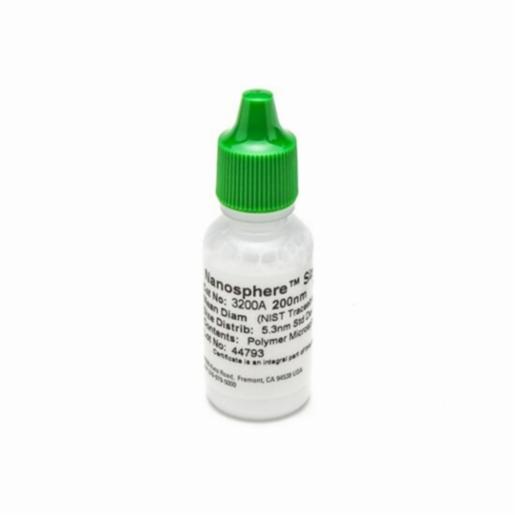
Malvern Panalytical 1.112mic/15ml POLYMER STANDARD LTX4011A
Malvern Panalytical -- Item TECPIM000004854
Please add to cart & request for quote to see the price
Reserve Now
Polystyrene polymer (latex) particle size standard LTX4011A (mean diameter 1.112 µm) supplied as a 15 mL suspension for instrument verification and routine validation. It provides a monodisperse, certified-size dispersion for verification of particle-sizing systems including dynamic light scattering (DLS) and other sizing techniques used in quality assurance and instrument performance checks. The formulation is supplied at 1% solids (w/v) in 15 mL and is optimized for easy dispersal and colloidal stability; dispersions can be stored at room temperature with storage lifetimes of months or years.
Key Features:
- Particle size: 1.112 µm (mean diameter).
- Volume: 15 mL suspension.
- Material: polystyrene latex (polymer) monodisperse spheres.
- Concentration: 1% solids (w/v) in 15 mL.
- Manufacturer part code: LTX4011A.
- NIST-traceable / certified-size dispersion.
Advantages:
- Enables objective verification and routine performance checks of particle-sizing instruments (for example DLS), supporting instrument validation workflows.
- Monodisperse, near-spherical polystyrene particles provide an unambiguous sizing reference and improve measurement reproducibility.
- Supplied as a 1% solids in 15 mL formulation optimized for easy dispersal and colloidal stability, simplifying sample preparation and handling.
- Dispersions can be stored at ambient temperature for months or years, aiding routine laboratory use and verification scheduling.
Product Details
Overview
| Model | |
|---|---|
| Product Type | Consumables |
| Part Number | LTX4011A |
| Brand | Malvern Panalytical |
| Gross Dimensions (WxDxH cm) | |
| Net Dimensions (WxDxH cm) | |
| Gross Weight (kg) | |
| Net Weight (kg) |
Specifications
More options are available. Please contact us for more information.
Document
More options are available. Please contact us for more information.
Videos


Malvern Panalytical
Malvern Panalytical instruments blend cutting-edge engineering with the latest advancements in data analytics and AI. This combination empowers industries and researchers to comprehend the world with unparalleled precision, from biomolecular structures to quantum dots.